
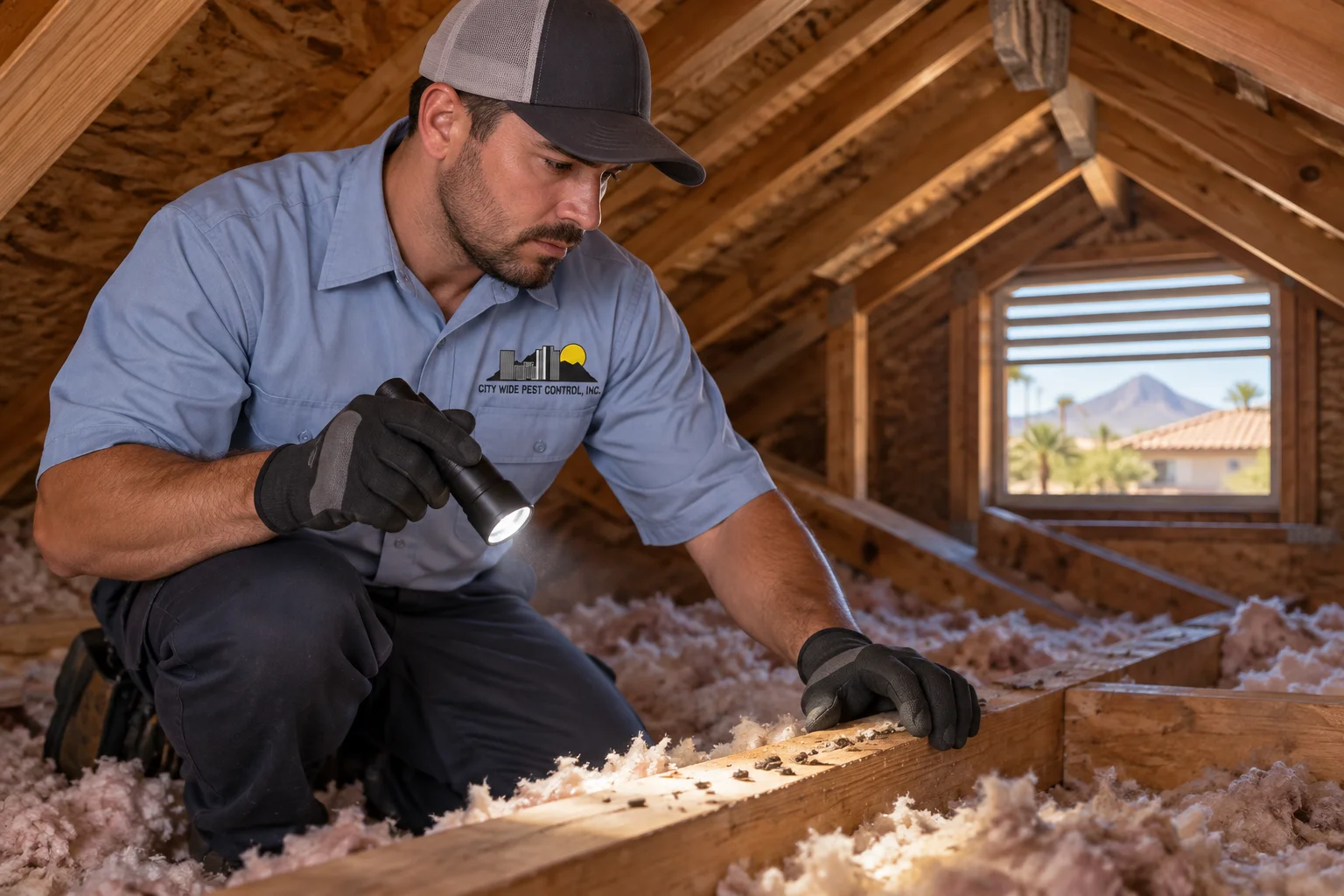
Rat droppings, mouse droppings, and roof rat droppings each have a distinct size, shape, and texture, and correct rodent droppings identification is the first step toward knowing what you are dealing with. If pellets are showing up in your Phoenix home, our Residential Rodent Control team can confirm the species and the scope of the problem.
By City Wide Pest Team
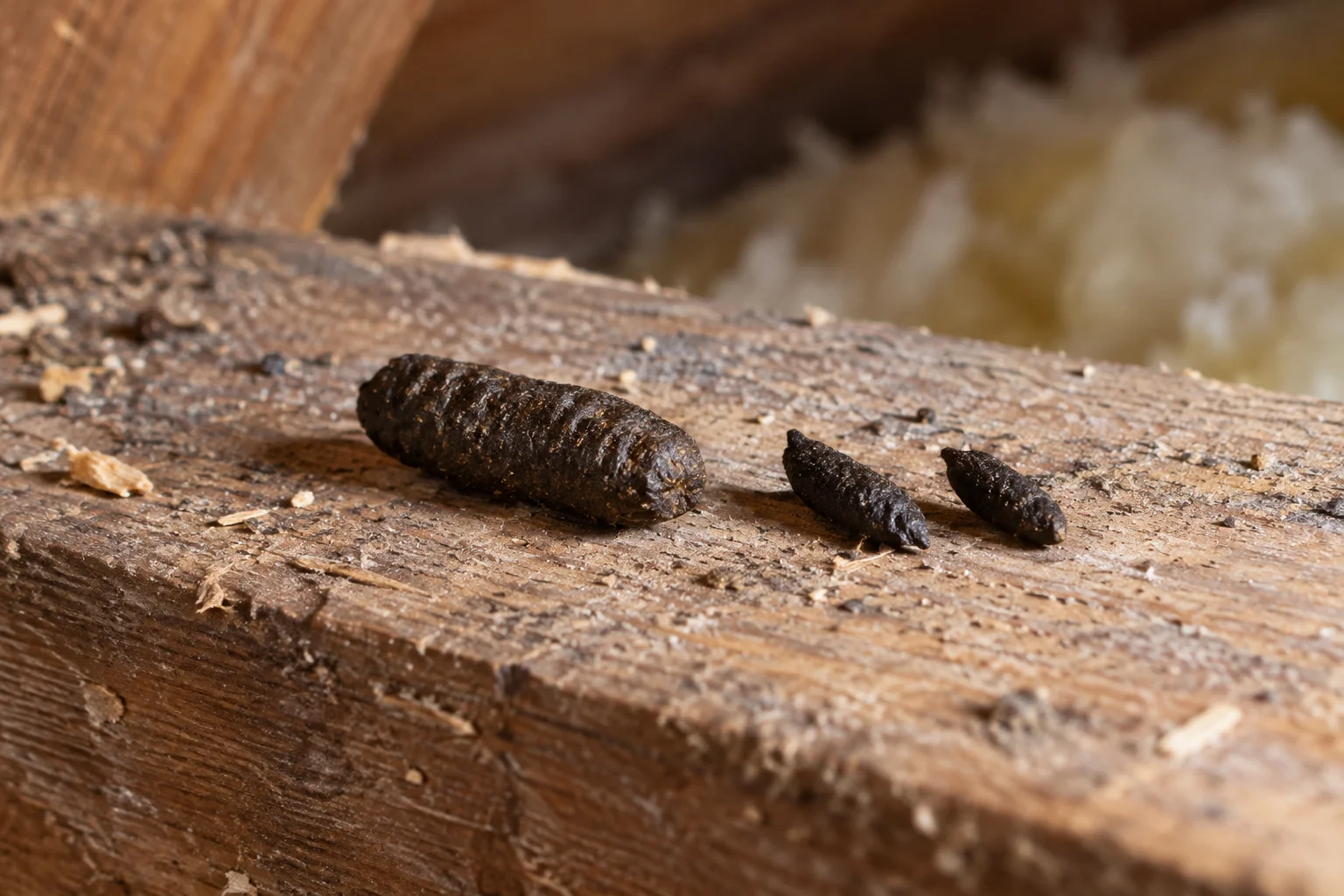
Whether you call it poop, pellets, or scat, identification starts with size and shape. Rat droppings run about three-quarters of an inch long, with blunt, rounded ends shaped like a small capsule or olive pit. Mouse droppings are closer to a quarter inch, thin and rod shaped with pointed, tapered ends, similar to a grain of rice. Both start dark and shiny when fresh and fade to a duller gray-brown with age.
Color alone rarely settles the question, since diet and moisture change the shade for both rats and mice. Size and shape are the more reliable signs: line a few droppings up next to a ruler, and the difference between rat and mouse droppings becomes obvious fast. That combination of size, shape, and color is usually enough to sort a pellet into the right category on sight.
How Can You Tell Roof Rat Droppings Apart from Norway Rat and Mouse Droppings?
Phoenix mostly deals with roof rats rather than Norway rats, and droppings tell the two apart even without seeing the animal. Roof rat droppings are spindle shaped with pointed ends, about a half inch long and slightly curved, closer to a large grain of rice than a capsule. Norway rat droppings are blunter and thicker, closer to three-quarters of an inch, with rounded tips, and they tend to cluster in flatter piles near ground-level runways.
Distinguishing rats from mice by size alone can be tricky, and roof rats add a third profile to sort out. Mouse droppings stay the smallest of the three, at roughly a quarter inch, and a pile that includes several sizes in the same spot can mean more than one species is active at once. That combination shows up often enough in Phoenix attics and garages that ruling out one species before treating for the other matters.
Where Do You Typically Find Rat Droppings Versus Mouse Droppings in a House?
Mouse droppings show up close to food and water: kitchen baseboards, inside cabinets, behind the stove, under the sink, and pantry corners where crumbs collect. Mice travel along walls and rarely cross open floor space, so their droppings trace a line rather than spreading evenly through a room.
Rat droppings turn up in different spots. Roof rats favor high, hidden spaces: attics, soffits, garage rafters, and the space above a false ceiling, since they enter a home from tree branches, roof lines, and utility wires rather than ground-level gaps. They leave droppings both in attics and on rooftops themselves, often near where a roof valley or vent stack gives them a resting spot before they head inside. Norway rats stay lower, favoring crawl spaces, garages, and areas near exterior foundations. Squirrels and other attic wildlife occasionally leave droppings too, and squirrel droppings tend to be larger and more rounded than roof rat pellets, which helps rule out a non-rodent animal before treatment starts.
Wherever you find them, droppings near stored food, dishware, or countertops deserve immediate attention, since that is the area where contamination risk to your family is highest. Recognizing these early signs keeps a small problem from spreading into every room of the house.
What Does Finding Fresh Rodent Droppings Mean About the Size of the Infestation?
A handful of droppings in one spot does not automatically mean a large population. A single mouse produces a surprising volume of waste on its own, so a small pile is not proof of a small problem, while a scattered scene across multiple rooms usually means more than one animal is active. What matters more than the count is the spread: droppings appearing in the kitchen, the garage, and the attic all in the same week points to an established infestation rather than one rodent passing through.
Fresh droppings are soft, dark, and slightly moist looking, while old droppings turn hard, dry, and grayish as they age over days to weeks depending on humidity. Finding fresh droppings alongside old ones in the same area usually means the population has been active for a while and is still growing, which is the point where a same-day inspection typically pays off rather than waiting to see if it gets worse. Ongoing exclusion and monitoring, the kind of routine visit covered under Residential General Pest Control, catches a new dropping trail early instead of after it spreads through the attic and kitchen both.
Are Rat or Mouse Droppings Dangerous to Touch or Breathe In, and How Do You Clean Them Up Safely?
Rodent droppings, also called rodent feces, can carry pathogens linked to hantavirus, salmonella, and leptospirosis. The health risk comes mainly from inhaling dust generated when dry droppings are swept, vacuumed, or disturbed. The Centers for Disease Control and Prevention recommends never sweeping or vacuuming dry rodent droppings, since that action aerosolizes particles that can then be breathed in.
To clean up safely: ventilate the area for at least thirty minutes before you start, wear rubber or latex gloves, and spray the droppings and surrounding surface with a disinfectant or a diluted bleach solution until thoroughly soaked. Let it sit for five minutes, then wipe up the wet debris with a paper towel and dispose of it in a sealed bag. Finish by disinfecting the whole surface and washing your gloved hands before removing the gloves. Avoid dry sweeping or vacuuming at any point in the process, and open windows rather than relying on the room's normal airflow.
For a large-scale cleanup, a heavy volume of droppings in an attic, or any site where you are not confident every dropping and nest area has been found, professional cleanup and exclusion work is the safer route, since spread-out contamination is easy to miss on your own.
What's the Difference Between Rat Droppings and Cockroach Droppings?
Rat and mouse droppings are solid, uniform pellets with a smooth, shiny surface when fresh. Cockroach droppings look different up close: German cockroach droppings resemble tiny dark specks or ground pepper, while American cockroach droppings are slightly larger, ridged along the sides, and often blunt on one end rather than pointed. Roach droppings also tend to collect in tighter clusters along grease residue, behind appliances, and inside cabinet hinges, while rodent droppings are more scattered along a travel path.
Fecal smear marks are another clue that separates the two: dark, greasy smear marks along baseboards point to roaches rubbing against a surface repeatedly, a pattern rodent droppings do not produce on their own. Telling the two apart matters for treatment, since a roach infestation and a rodent problem call for different baiting and exclusion approaches even when they are found in the same kitchen.
Frequently Asked Questions
How many droppings does a mouse leave in a day?
A single mouse typically leaves fifty to seventy droppings in a twenty-four hour period, since mice defecate constantly as they move and forage. That volume is why even one mouse can make an infestation look larger than it is, and why a small kitchen can accumulate dozens of pellets in days without a large population behind it.
Can you tell how long ago rodent droppings were left?
Fresh droppings are dark, soft, and slightly shiny, while droppings older than a few days turn hard, dry, and dull gray as moisture evaporates. Arizona's dry climate speeds that aging compared to humid regions, so a soft, moist dropping usually means rodent activity within the last day or two rather than an old, abandoned trail.
What should I do if I find rodent droppings in my kitchen?
Avoid sweeping or vacuuming the area, since dry droppings can release airborne particles. Ventilate the room, disinfect the droppings and surrounding surfaces with a bleach solution or commercial disinfectant before wiping them up, and check nearby cabinets, the pantry, and behind appliances for a wider trail. Droppings found near food prep areas are worth a same-day cleanup rather than waiting on a full inspection.
Can droppings alone tell you which rodent species you have?
Droppings are one of the most reliable field clues, but size and shape can overlap between an older Norway rat and a very active roof rat, or between a mouse and a young rat. Combining dropping evidence with gnaw marks, grease trails, nesting material, and entry points gives a more confident identification than droppings by themselves.
When should I call a pest control professional about rodent droppings?
Call sooner rather than later if droppings show up in more than one room, if you find fresh droppings alongside old ones, or if the location, an attic, a commercial kitchen, or a space near stored food, makes cleanup risky to handle yourself. An inspection can confirm the species, locate entry points, and scope the problem before it grows.
Get Help Identifying What's Really in Your Home
If the droppings you are finding do not clearly match one category, City Wide Pest Control has been reading rodent sign across Maricopa County for over 40 years as a locally owned, family-owned business, not a franchise. Contact Us to schedule an inspection and get a clear answer through professional rodent droppings identification.