


Paradise Valley Pigeon Control Done by a Local Family Company

Family owned City Wide Pest Control brings over 40 years of experience to pigeon control in Paradise Valley and across Maricopa County.

Residential Pigeon Removal in Paradise Valley, Arizona

Pigeons settle in quickly and are slow to move on. They favor rooftops, tile roofs, patio covers and the shaded gap under solar panels, and their droppings can stain and wear down roofing, stucco, painted surfaces and concrete. With warm weather nearly all year and food and water easy to find, a roost that starts small tends to grow. Acting early makes the fix simpler for you and gentler on your home.
As a locally owned and operated team providing bird control in Paradise Valley, we pair deterrents with exclusion work to move pigeons off your property and keep them from settling again. Proofing extends to solar arrays, tile roofing and every other spot birds like to perch. Residential customers never sign a contract, and our technicians are licensed by the Arizona Department of Agriculture, Pest Management Division (Arizona license #2317).
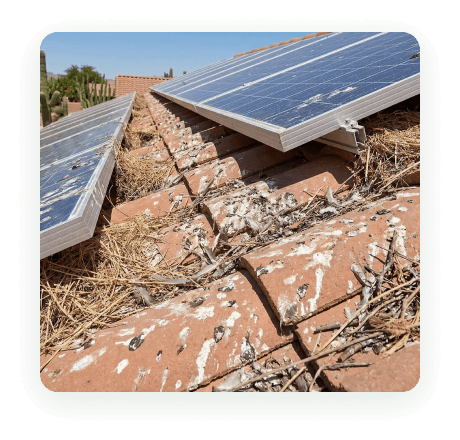
Pigeon droppings and nesting debris under rooftop solar panels
Years Serving Maricopa County
0 +

Noticing any of these signs? Don't wait.

Signs You May Have Pigeons

Look for these clues around your home or property.

Pigeons gathering on the roof, a patio cover, or outdoor ledges

Nests tucked into roof tile gaps, beneath solar panels, or in shaded alcoves

Droppings piling up on patios, walkways, pool decks, or outdoor furniture

Droppings near rooftop air conditioners, evaporative coolers, or vents

Soft cooing and shuffling from roosting birds at first light

Twigs, feathers, and other nesting debris collecting in gutters or on the ground below

If any of this sounds familiar, call (602) 944-0099 and we will assess your property.
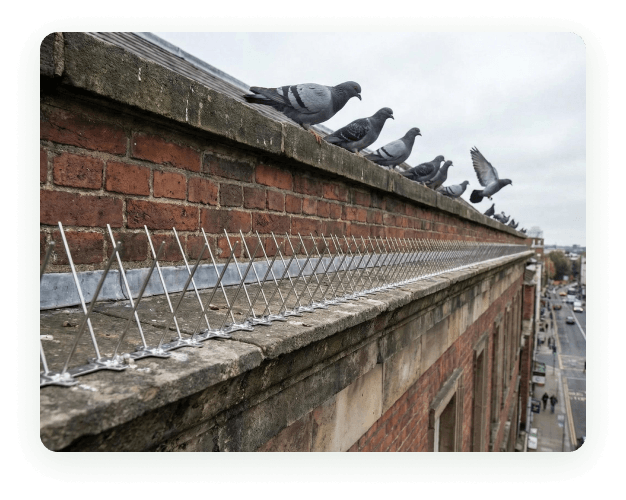
Pigeons roosting along a commercial building ledge fitted with bird spikes

Why Pigeon Control Is Worthwhile

Pigeon droppings are acidic, so over time they can eat into roofing, paint, stucco, concrete and car finishes. Once dried, they can also release dust carrying pathogens such as Histoplasma, Chlamydia psittaci and Cryptococcus, a genuine health concern for anyone nearby.
Pigeons can also bring bird mites, lice and ticks, which sometimes move indoors once birds have nested on the building. Under solar panels, the debris can cut panel performance and add a fire hazard. Without proper deterrents and exclusion, pigeons tend to come back to the same roost, generation after generation.

Speak to a real person, not a robo machine.

Pigeon Control for Paradise Valley Homes

Paradise Valley was incorporated on May 24, 1961, as a one-house-per-acre, entirely residential community, and residents ratified the 2022 General Plan vision of keeping it primarily one-acre residential with 81% of the vote on August 2, 2022. That means roofs, patio covers and solar arrays belong to individual homeowners, and our technicians treat each property on its own terms. Our bird removal in Paradise Valley starts with a walk around your roofline.
The Town lists an average July high of 104 F and 294 sunny days a year, so shaded gaps under tile and panels are worth checking in every season. If your home sits near the trailheads off Tatum Boulevard at East Tomahawk Trail, near Lincoln Drive and 32nd Street, or on the lower slopes of Mummy Mountain, you get the same careful inspection and exclusion work.
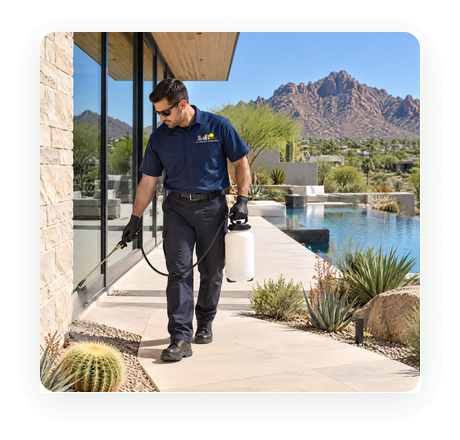
City Wide Pest Control technician treating the perimeter of a luxury estate with mountain views in Paradise Valley, AZ

How Our Pigeon Control Works

Step 1
Assessment
First, we inspect the property to locate roosts, nests, access points beneath solar arrays or tile roofing, and how active the birds are.
Step 2
Deterrent Installation
Bird spikes, deterrent wire and exclusion netting are fitted along rooflines, patio covers, ledges and other perches so pigeons cannot land.
Step 3
Solar Panel Exclusion
Mesh screening goes around solar arrays to close the space between panels and roof, removing the sheltered nook pigeons like to nest in.
Step 4
Nest and Debris Removal
Old nests, eggs and built-up droppings are cleared away, and the affected surfaces are cleaned.
Step 5
Follow-Up
We return to confirm the deterrents are holding, the birds have moved on, and no new nests have started.

Meet the Common Feral Pigeon

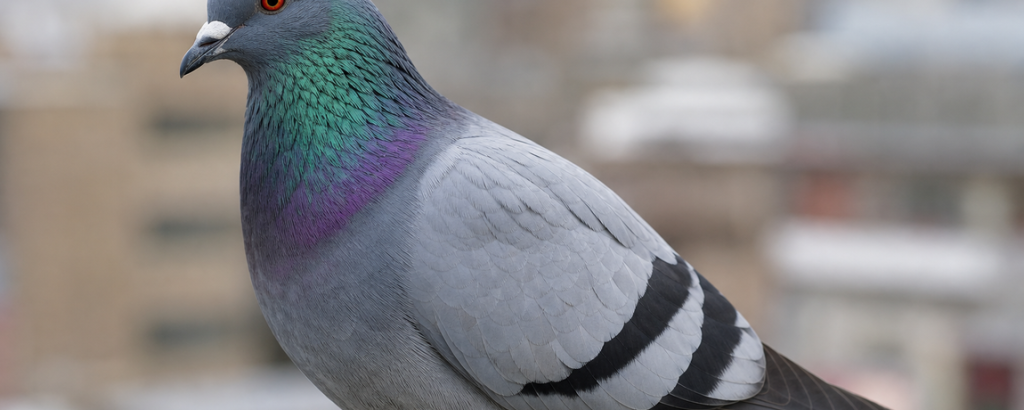
Rock pigeon (Columba livia) perched on a building ledge
Rock Pigeon
Columba livia
The common feral pigeon is gray with a green and purple sheen on its neck, 11 to 14 inches long, and stocky. Its ancestors nested on cliffs, so rooftops, ledges and overhangs suit it well. It adapts easily and can breed in any month, raising several broods a year in Arizona.
Feral pigeon numbers across the region have grown alongside development. They gravitate to neighborhoods offering solar panels, tile roofs, pet food, birdseed, trash, and water from pools or irrigation. Pigeons are habitual, so once a roost is set they keep returning to it unless it is physically blocked.

Family owned since 1986. No contracts required.

Simple Prevention Tips for Homeowners

A few easy habits can limit pigeon activity between our visits.
City Wide Pest Control brand-green shield with checkmark prevention icon

Skip feeding pigeons, and keep pet food, birdseed and scraps put away outdoors

City Wide Pest Control brand-green shield with checkmark prevention icon

Keep trash cans and dumpster areas closed with snug lids

City Wide Pest Control brand-green shield with checkmark prevention icon

Reduce drinking water by repairing irrigation leaks and covering the pool when possible

City Wide Pest Control brand-green shield with checkmark prevention icon

Fit deterrents on flat perches as soon as pigeons start landing, before a colony forms

City Wide Pest Control brand-green shield with checkmark prevention icon

Add exclusion mesh around solar panels before birds start nesting beneath

City Wide Pest Control brand-green shield with checkmark prevention icon

Clear old nesting material right away, since pigeons rebuild quickly if you only knock it down

Why Choose City Wide Pest Control

Family owned since 1986

over 40 years protecting East Valley desert communities

No contracts

for residential, stay because it works

State-licensed staff

technicians AND office personnel licensed by the Arizona Department of Agriculture

Government-trusted

contracts with State, County, and City buildings, along with several school districts

Green, kid friendly, pet friendly

IPM approach suited to desert environments

Real people

call (602) 944-0099, talk to an account manager, not a robo machine
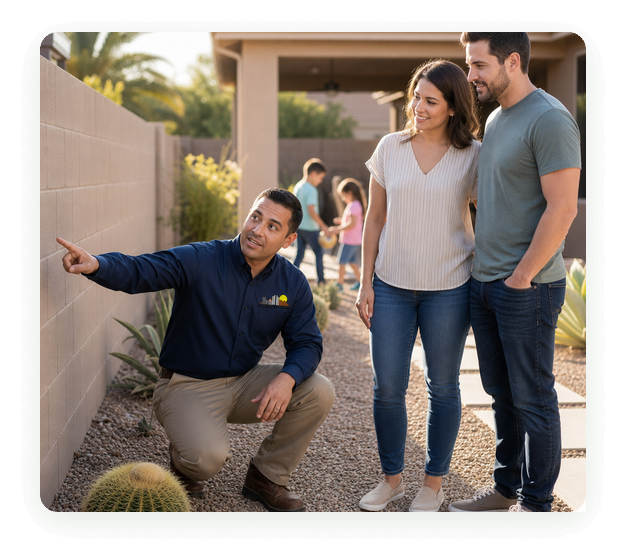
City Wide Pest Control technician showing a Phoenix family where he will treat their backyard

Let's Solve Your Pest Problem the Right Way

Protect your roof, solar panels and outdoor living space with help from City Wide Pest Control, a pigeon exterminator in Paradise Valley that homeowners can call with confidence. We are family owned, based in Phoenix, and have served Arizona homes since 1986. Residential service never requires a contract, and there is no pressure, only straightforward work.

Frequently Asked Questions

Who handles pigeons on the Town of Paradise Valley's wildlife list?
The Town’s Wildlife Services list notes that pigeons are handled only by one listed licensee, Allen Animal Control, and the Town says it does not endorse any listed provider. City Wide Pest Control is a separate Arizona-licensed company (license #2317) that offers residential pigeon service. Call (602) 944-0099, Monday to Saturday, 8 to 5.
The Town covers about 15.4 square miles and counted 12,658 residents and 5,046 households in the 2020 Census, and its General Plan keeps it primarily one-acre residential. Since each home stands on its own, we inspect your roofline, patio covers and solar panels individually, then recommend only what that property needs.
The Town lists an average July high of 104 F, 7.3 inches of annual rainfall and 294 sunny days a year. Warm weather lets pigeons nest in any month, so shaded spots under tile and solar panels deserve a look in every season. We check those areas on each visit.
Pigeons are habitual. If a spot gives them shelter, food or water, they return to it again and again. Lasting results come from physically closing off nesting gaps, adding deterrents to ledges, and removing pet food, birdseed and open trash that attract them.
Often, yes. Pigeons readily reuse a sheltered nest site and can raise several broods a year, laying eggs in any month where winters are mild. Eggs generally hatch in about 18 days. Clearing old nests and sealing the spot is what keeps birds from returning.
Pigeons settle into a roost around dusk and stay until morning, which is why early cooing is often the first sign. They pick sheltered, elevated spots such as ledges, patio covers and the gap under solar panels because those places feel protected.

Pigeon Control Near Paradise Valley

Explore our Paradise Valley hub, the main Pigeon Control page, and the nearby cities we serve across Maricopa County.