



Bee Removal for Queen Creek Homeowners

City Wide Pest Control offers bee removal in Queen Creek backed by over 40 years of service across Maricopa County, from a locally owned and operated team.

Your Bee Exterminator in Queen Creek, Arizona

Bees and wasps are part of desert life, and a nest near your home calls for a careful, professional response. Wild honey bees in Arizona are considered Africanized, so a colony in a wall void, attic or shed is not something to put off. Wasps favor sheltered spots such as patio covers, porch ceilings and garage corners, close to where your family relaxes. Our crew handles wasp removal in Queen Creek with the same care.
City Wide Pest Control has been family owned since 1986 and is based in Phoenix, led by owners Mike and Steven. Our Africanized bee emergency line, (602) 576-5452, connects you with a team that treats every bee call as urgent. Technicians and office staff alike are licensed by the Arizona Department of Agriculture, Pest Management Division.
City Wide Pest Control technician inspecting a garage door seal for pest entry at a Queen Creek, AZ home
Years Serving Maricopa County
0 +

Signs of a Bee or Wasp Problem at Home

Here is what to look for around your home or yard.

A steady line of bees traveling to and from a gap in a block wall, stucco or roofline

Visible honeycomb or a growing hive on a tree, shed, eave or meter box

More bees than usual hovering around one spot of your house or yard

Papery wasp nests hanging beneath eaves, patio covers or in garages

Bees slipping in through weep holes, pipe openings or cracks along the roofline

A cluster of bees resting on a tree, fence or building, which may be passing through or settling in

If bees are swarming or acting aggressively, call our Africanized bee emergency line at (602) 576-5452.

Bees or Wasps Nearby? Call Today

Call City Wide Pest Control for prompt, professional bee and wasp removal in Queen Creek, with same-day service available. Residential service never requires a contract, and our family owned team has looked after Arizona homes since 1986.
24-Hour Bee Emergency: (602) 576-5452
General Scheduling: (602) 944-0099
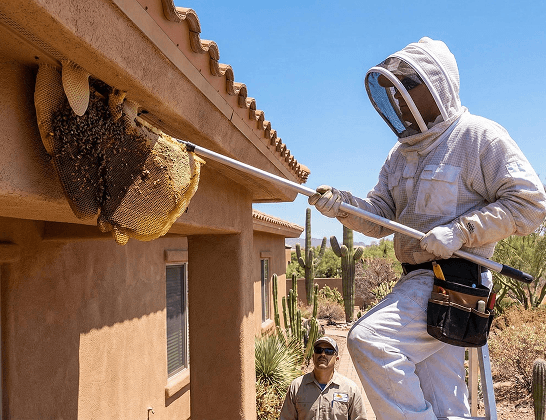
A beekeeper in a protective suit removing a bee colony from a Phoenix roofline

Why Professional Removal Is Worth It

Professional bee control in Queen Creek matters because wild honey bees in Arizona are considered Africanized, according to University of Arizona Extension. They tend to nest in hollow block walls, wall voids and in-ground irrigation boxes, and they swarm especially in spring and summer. That makes a do-it-yourself approach a poor bet, since a disturbed colony can respond in large numbers.
Some people have serious allergic reactions to stings, and many stings at once can be dangerous even for people without allergies. Good wasp control in Queen Creek matters too, since paper wasps and yellow jackets defend their nests firmly. Colonies inside walls bring other trouble: honey draws ants and roaches, and melting comb can harm drywall and stucco.

Speak to a real person, not a robo machine.

What Queen Creek Homeowners Should Know About Hives

Queen Creek lies in both Maricopa and Pinal counties, bordered by Mesa to the north, Gilbert to the west, Apache Junction to the northeast, unincorporated San Tan Valley to the east and San Tan Mountain Regional Park to the south. Hollow block walls, wall voids and in-ground irrigation boxes are all worth checking in neighborhoods such as Circle G, QC Ranchettes and Creekview, which sit on the town’s flood irrigation schedule.
Town rules apply here as well. Town Code 6-3-2 requires a beekeeping license before anyone keeps a hive, colony or apiary in town limits, and Code 6-3-3 puts hives in R-1-35 or smaller residential zones at least 30 feet from any exterior property line. Property owners are exempt under 6-3-5 where a transient swarm is trying to settle, while 6-3-7 presumes unmarked, unlicensed hives abandoned, so the town can remove them on complaint.
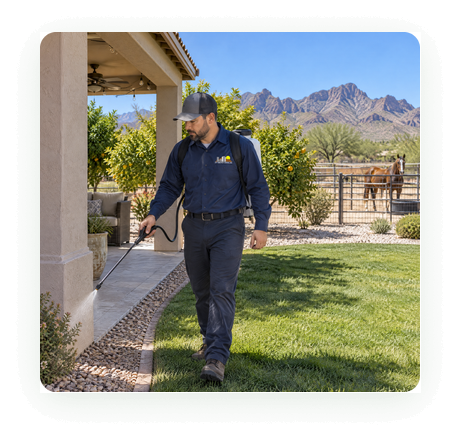
City Wide Pest Control technician treating a large backyard at a ranch-style home in Queen Creek, AZ

How Our Removal Process Works

Step 1
Emergency Response
If a swarm or an active hive is the issue, call right away. Same-day service is available, and the Africanized bee emergency line is (602) 576-5452.
Step 2
Assessment
We confirm the species, find the nest or hive, gauge its size and reach, and weigh the risk to your household and property.
Step 3
Safe Removal and Treatment
We treat and remove nests with professional equipment. For bees in a wall void, we treat the colony, then plan the extraction and sealing with you so they do not return.
Step 4
Entry Point Sealing
Once the colony is gone, we close the openings it used. Empty cavities can draw new bees in again within weeks.
Step 5
30-Day Warranty
Every bee removal job is backed by our 30-day warranty on the treated area.

Common Bees and Wasps in Queen Creek

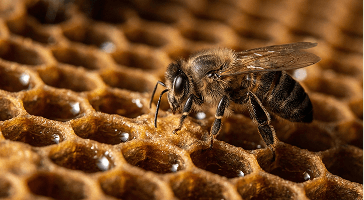
Close-up of an Africanized honey bee on honeycomb
Africanized Honey Bee
Apis mellifera scutellata hybrid
Look much like European honey bees but are far more defensive. They settle in sheds, meter boxes, in-ground irrigation boxes, hollow block walls and wall voids, and react in force when disturbed. Wild honey bees in Arizona are considered Africanized.
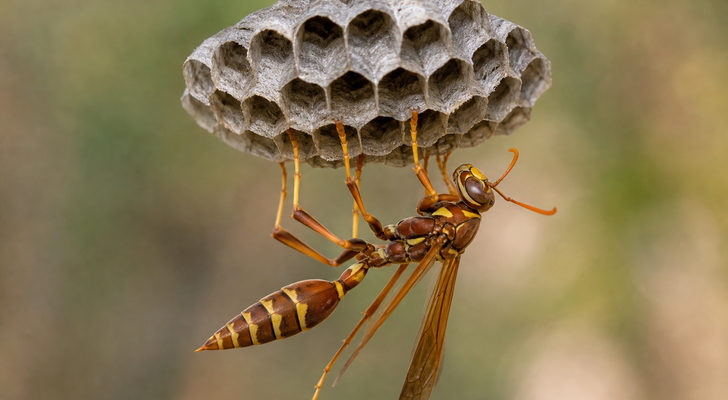
Paper wasp (Polistes) on the open hexagonal comb of its paper nest
Paper Wasp
Polistes spp.
Slim wasps about 3/4 to 1 inch long, from rust colored to dark brown. Small paper nests with open cells hang from porch ceilings, patio covers and garden furniture. Calmer than Africanized bees, yet they sting if a nest is bumped.
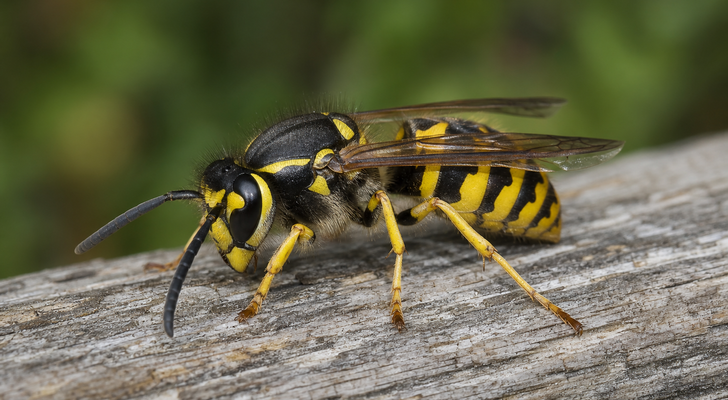
Western yellowjacket (Vespula pensylvanica), black and yellow banded wasp on weathered wood
Yellow Jacket
Vespula spp.
Stocky, black with bright yellow markings, about 1/2 inch long. Pushy around food and drinks, so common at outdoor parties. They often nest in attics, wall voids and underground cavities, and can sting more than once.

Simple Prevention Tips for Homeowners

A few habits can keep activity down between professional visits.
City Wide Pest Control brand-green shield with checkmark prevention icon

Close up cracks around rooflines, eaves, stucco and block walls, because scout bees check out cavities well before a colony moves in

City Wide Pest Control brand-green shield with checkmark prevention icon

Cover or screen weep holes and pipe openings along outside walls

City Wide Pest Control brand-green shield with checkmark prevention icon

Check the yard and house monthly for fresh signs of bees, particularly in spring and summer

City Wide Pest Control brand-green shield with checkmark prevention icon

Move flowering plants away from entry doors and patios, where bees tend to gather

City Wide Pest Control brand-green shield with checkmark prevention icon

Keep trash cans clean and tightly lidded so yellow jackets look elsewhere

City Wide Pest Control brand-green shield with checkmark prevention icon

Leave active hives to a licensed professional, since wild honey bees in Arizona are considered Africanized

Why Choose City Wide Pest Control

Family owned since 1986

over 40 years protecting East Valley desert communities

No contracts

for residential, stay because it works

State-licensed staff

technicians AND office personnel licensed by the Arizona Department of Agriculture

Government-trusted

contracts with State, County, and City buildings, along with several school districts

Green, kid friendly, pet friendly

IPM approach suited to desert environments

Real people

call (602) 944-0099, talk to an account manager, not a robo machine

City Wide Pest Control technician reviewing a residential pest control plan with a Phoenix homeowner

Let's Solve Your Pest Problem the Right Way

Questions about a nest or hive? Call (602) 944-0099, Monday to Saturday, 8 to 5, and we will help you plan your next step. We also handle beehive removal in Queen Creek with no contract required for residential service.

Frequently Asked Questions

Do you offer bee removal in Queen Creek, AZ?
Yes. We are a locally owned and operated company serving more than 25 cities across Maricopa County, and we handle bees and wasps at Queen Creek homes. We find the hive or nest, remove it, and seal the entry points. Bee work carries a 30-day warranty, and residential service has no contract. Call (602) 944-0099, Monday to Saturday, 8 to 5.
Queen Creek Town Code 6-3-2 requires a town beekeeping license before anyone keeps a hive, colony or apiary within town limits. Under 6-3-3, hives in R-1-35 or smaller residential zones must sit at least 30 feet from any exterior property line, with a permanent water supply within 30 feet. If you found a colony you did not place, call us and we will take a look.
Town Code 6-3-5 exempts property owners where a transient swarm is trying to settle. A swarm may move on or may establish a hive, so keep people and pets away and call our Africanized bee emergency line at (602) 576-5452. Please do not spray it yourself. We will assess the situation and explain the next step.
University of Arizona Extension says wild honey bees in Arizona are considered Africanized, nest in hollow block walls, wall voids and in-ground irrigation boxes, and swarm especially in spring and summer. That makes irrigation boxes worth checking in neighborhoods like Circle G, QC Ranchettes and Creekview, which are on the town’s flood irrigation schedule.
Usually not. Yellow jackets tend to be the pushier of the two, especially around food and drinks, and they can sting more than once. Paper wasps are calmer but will sting if their nest is disturbed. Either way, a nest near a door or patio is best handled by a licensed technician rather than a spray can.
Call a licensed pest professional rather than tackling a nest yourself. City Wide Pest Control offers same-day service, Monday to Saturday, 8 to 5, at (602) 944-0099. As a wasp exterminator in Queen Creek, we remove the nest and treat the area. Our technicians and office staff are licensed by the Arizona Department of Agriculture, Pest Management Division.

Bee and Wasp Removal Near Queen Creek

Explore our Queen Creek pest control hub, the main Bee and Wasp Removal page, and the nearby cities we serve.