
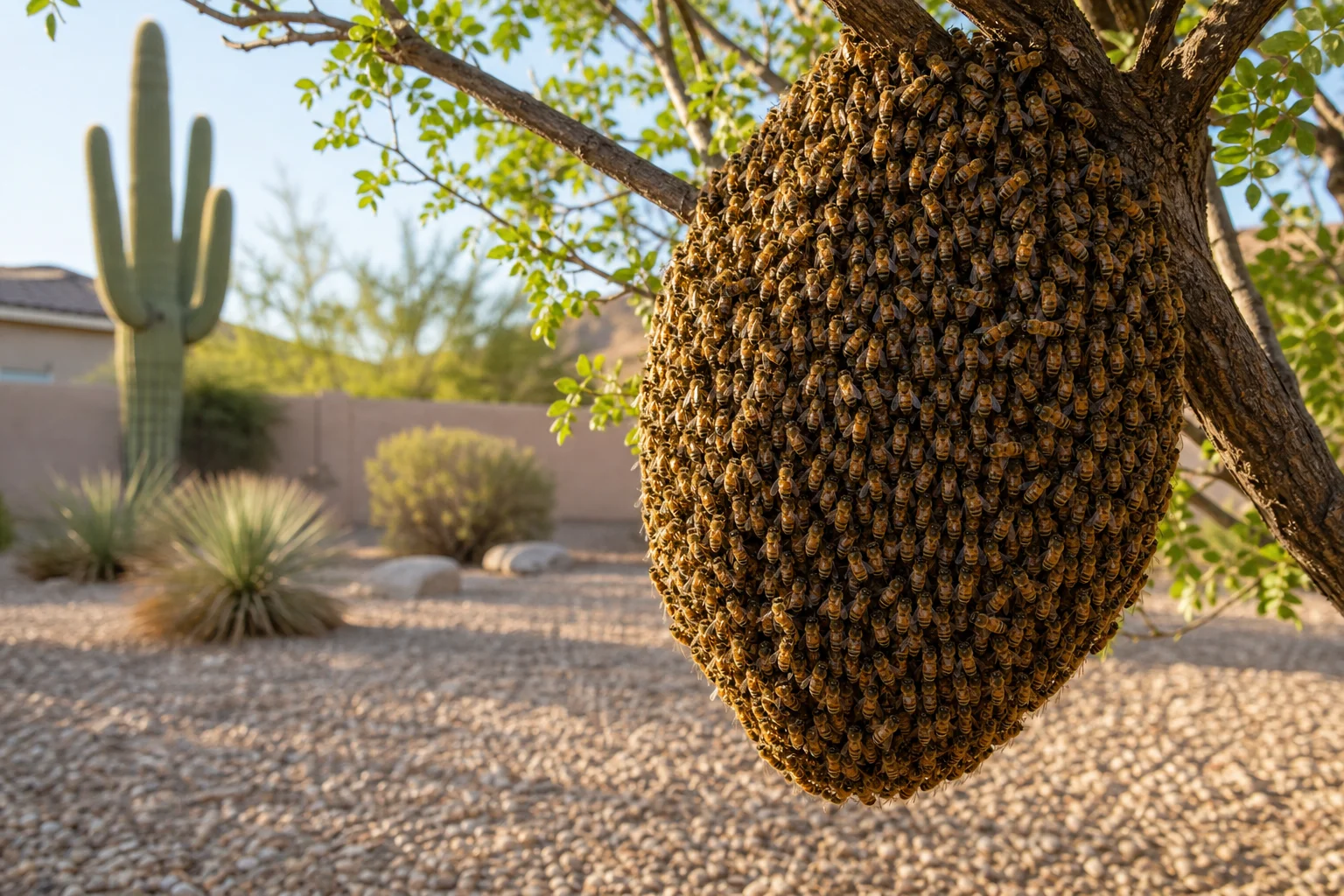
Africanized bees in Arizona defend their hives with far more intensity than the European honey bees most homeowners picture, which is why a swarm near a patio, shed, or irrigation box calls for professional Residential Bee & Wasp Removal instead of a garden hose. Here's what actually makes these bees dangerous, and what does not.
By City Wide Pest Team
What Makes Africanized Bees in Arizona More Defensive Than European Honey Bees?
Africanized bees in Arizona are not more venomous than the European honey bees kept in backyard hives across the Valley, but their temperament is a different story. A European honey bee colony typically sends out a handful of guard bees when disturbed and settles down within a few minutes. An Africanized colony can respond to the same disturbance, a lawn mower, a bumped wall, a curious dog, with ten to twenty times more defenders, and those defenders stay agitated far longer. They also react to smaller disturbances from farther away, so a person doesn't need to touch a hive to trigger a response. This is the trait that actually matters for homeowners: it isn't the sting itself, it's the number of bees willing to deliver one and how little provocation it takes to set them off. Pest control professionals treat any unmanaged honey bee colony in the Phoenix area as Africanized until proven otherwise, because that assumption is safer for the person doing the inspection.
How Can You Tell Africanized Bees Apart From European Honey Bees?
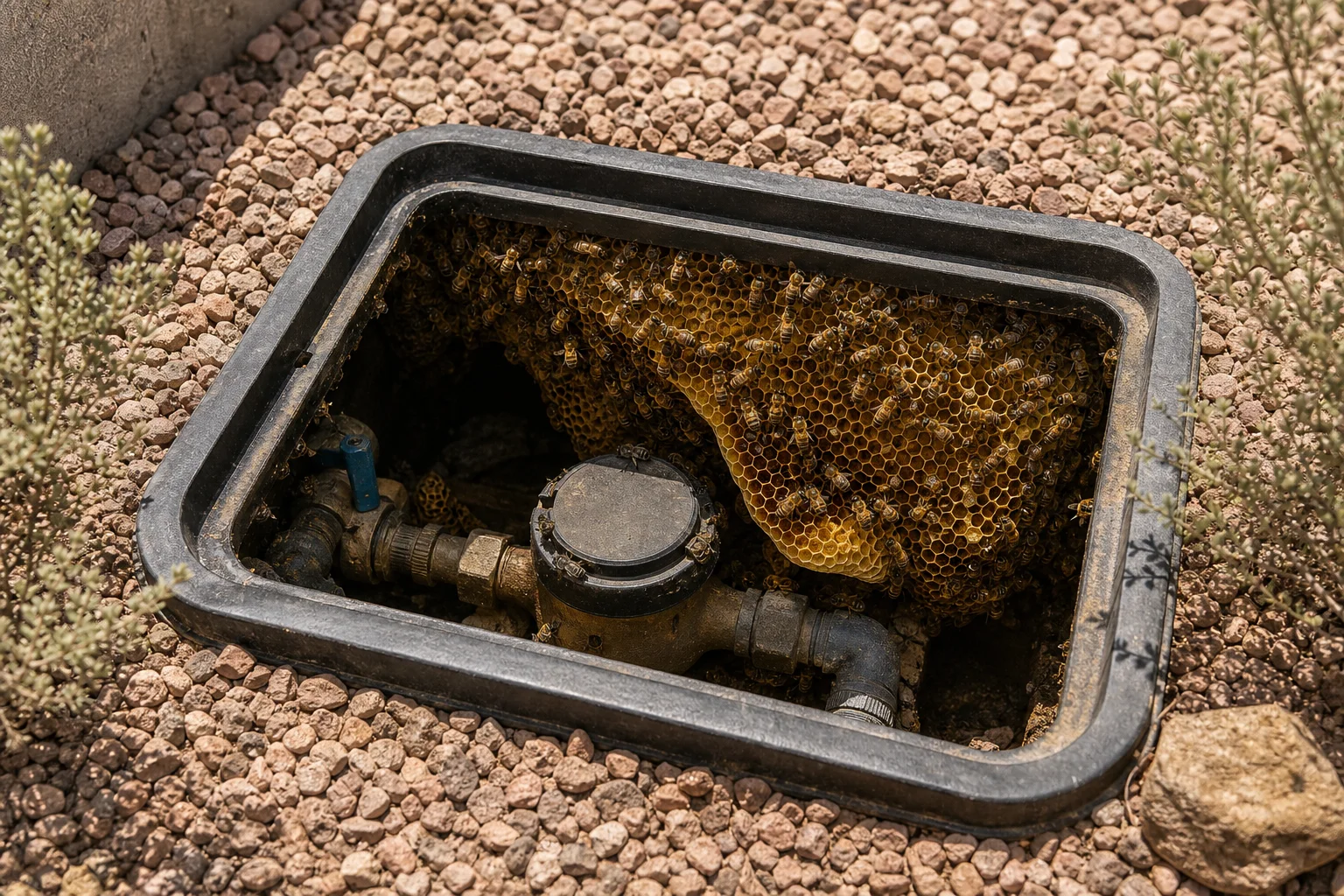
Visually, you mostly can't. Africanized bees run slightly smaller than European honey bees on average, but the difference is a few millimeters, not something a homeowner can judge in a moving swarm. Entomologists distinguish the two through morphometric measurement (comparing wing vein patterns and body proportions under magnification) or genetic testing, tools that aren't practical outside a lab. In the field, behavior is the more reliable clue. A colony that reacts strongly to noise or vibration from 20 feet away or more, that keeps stinging well after the disturbance has stopped, or that has moved into an unusual cavity such as a water meter box, a block wall void, or a stacked pile of yard equipment is far more likely to be Africanized. Nest location matters too: European honey bees generally prefer larger, sheltered cavities, while Africanized colonies will readily set up in a small gap that would never house a European hive.
Why Are Africanized Bees Called Killer Bees?
The name traces back to a 1956 breeding program in Brazil, where researchers crossed African honey bee subspecies with European stock already established in South America, aiming for bees better suited to tropical honey production. In 1957, swarms from that program escaped quarantine, and the bees Africanized through that crossbreeding spread north through Central America and Mexico over the following decades, reaching Texas and Arizona by the early 1990s. Media coverage of fatal swarm attacks during that spread popularized the killer bees name, and it stuck. The name overstates the individual risk somewhat: one Africanized bee sting carries the same venom and the same medical risk as one European honey bee sting for a person without a bee allergy. What earns the name is the group response. A person who disturbs an Africanized colony can end up with dozens or hundreds of stings in a single encounter, and that cumulative dose is what turns a manageable event into a medical emergency.
Where in Arizona Are Africanized Bees Most Commonly Found?
Africanized bees in Arizona are now established across nearly all of the state's lower elevations, including all of Maricopa County and the greater Phoenix metro. They favor the same features that make Sonoran desert properties livable for people: irrigation boxes, water meter vaults, block wall crevices, palm tree skirts, sheds, and attic voids all make attractive nesting cavities. Activity picks up noticeably from March through October, when warmer temperatures drive colonies to swarm and establish new hives, though an established colony can turn up on a property at any time of year. Commercial properties see the same pressure as homes, loading docks, irrigation equipment enclosures, and vacant units all turn up feral colonies regularly, which is why City Wide's Commercial Bee & Wasp Removal team handles hive calls at warehouses, retail centers, and HOA common areas across the Valley just as often as single-family homes.
What Should You Do If Africanized Bees Attack You or Find a Hive on Your Property?
If bees are actively stinging, run in a straight line away from the hive and get indoors or into a closed vehicle as fast as possible; Africanized bees track movement and carbon dioxide, so erratic dodging or standing still both prolong the encounter. Cover your face and head with clothing as you run, don't swat at bees (crushed bees release an alarm pheromone that recruits more defenders), and never jump into a pool or pond, bees will wait at the surface. Once you're inside, close doors and windows and deal with any bees that followed you in one at a time rather than opening the door again.
If you find a hive and haven't been attacked, keep the area clear: rope it off, keep kids and pets away, and don't throw rocks, spray a garden hose, or apply a store bought pesticide, all three are common triggers for a mass defensive response and none of them reliably kill the colony. Call a licensed pest control company to assess the hive's location, size, and temperament before anyone gets close again.
Can Africanized Bees Be Removed Safely, or Should They Always Be Exterminated?
It depends on the hive, not a blanket rule. A colony discovered in an open, low traffic area, a fence line at the edge of a large lot, for example, can sometimes be live relocated by a beekeeper equipped to handle a defensive colony. A colony established inside a wall void, an attic, or a water meter box near a walkway is usually too great a risk to relocate safely, both to the technician and to anyone nearby during the process, and extermination followed by comb removal is the more responsible option. A licensed pest control provider makes that call after inspecting the hive in person, checking location, accessibility, colony size, and how defensively the bees are already behaving. Removal should always include pulling the comb once the bees are gone; leftover comb draws a new colony back to the same cavity within weeks.
Are Africanized Bees Taking Over Honey Bee Colonies in Arizona?
Largely, yes, for feral, or unmanaged, colonies. Decades of interbreeding mean most wild honey bee colonies found in Arizona today carry significant Africanized genetics, which is part of why pest control companies default to treating any unmanaged hive as Africanized. That said, this isn't the same as European honey bees disappearing. Managed hives kept by local beekeepers, the ones producing honey in backyard apiaries around the Valley, are actively bred and requeened to keep temperament gentle, and those colonies stay meaningfully calmer than feral ones. The practical takeaway for a homeowner is simple: a managed hive with a known beekeeper is a different situation than an unmanaged colony that moved into a wall void on its own, and only the second one is a pest control call.
Frequently Asked Questions
How dangerous are Africanized bee stings to humans and pets?
A single sting is about as dangerous as any honey bee sting: painful but not medically serious for most people, unless they have a bee venom allergy, in which case any sting can be life threatening and needs immediate medical attention. The real danger with Africanized bees is volume, dozens or hundreds of stings from one aggressive colony response. Pets are at higher risk because they can't outrun a swarm as effectively and often can't be gotten to shelter as quickly as a person.
How far will Africanized bees chase a person?
Africanized bees will typically pursue a perceived threat much farther than European honey bees, in some cases a quarter mile or more, and for longer, sometimes 15 minutes or beyond after the initial disturbance. Distance and duration vary by colony size and how provoked the bees were. The safest response is always to keep moving toward an enclosed space, a house or a car, rather than trying to outlast the pursuit out in the open.
How many bee stings is dangerous or fatal?
For a person without a venom allergy, medical sources generally place serious risk starting around several hundred to several thousand stings, though this varies with body weight, age, and overall health. For someone allergic to bee venom, a single sting can trigger anaphylaxis and become fatal within minutes without treatment. Anyone stung more than a handful of times, or who shows swelling beyond the sting site, dizziness, or trouble breathing, should seek emergency care immediately.
How much does Africanized bee removal cost in Arizona?
Cost depends on the hive's location, size, accessibility, and whether comb removal or structural repair is needed, so there isn't one number that applies to every job. City Wide provides a free inspection and a written quote before any removal work begins, so you know the scope and cost upfront before agreeing to anything.
Get Africanized Bees Removed From Your Property Safely
City Wide Pest Control has handled bee and wasp calls across Maricopa County for over 40 years as a locally owned, family run business built by the same owner since 1986. If you've spotted a hive or an unusually defensive swarm on your property, Contact Us and a licensed technician will assess it before anyone gets close again.