
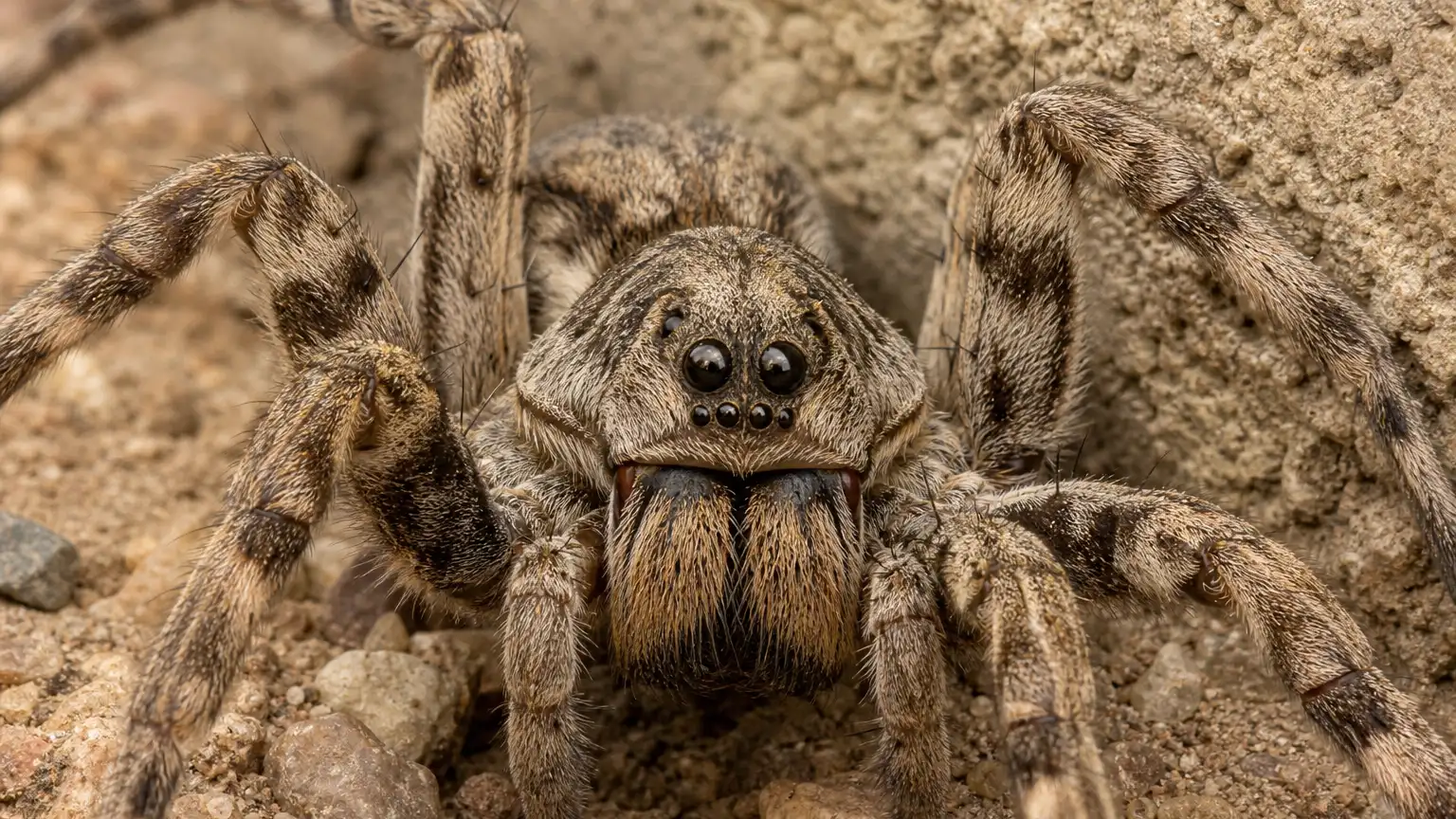
A wolf spider vs brown recluse mix up is why healthy, prey eating spiders get squashed across the Valley every week. Type "brown recluse wolf spider" or "wolf spiders brown recluse" into a search bar, or ask an assistant which one is in your garage, and the answer comes down to the eyes: a wolf spider carries eight in three rows, with two oversized center eyes; a true recluse shows only six, in three neat pairs. Arizona, notably, has no established population of the actual brown recluse at all, and confirming which one is in your garage is exactly what a spider identification visit settles in minutes.
Count the Eyes First: The Fastest Way to Tell Them Apart
Forget color and forget size. Both spiders come in shades of tan to dark brown, and a big wolf spider can look every bit as alarming as a recluse to someone who just flipped on a garage light. The one feature that never lies is eye count and arrangement.
Wolf spiders (family Lycosidae) carry eight eyes arranged in three rows: four small eyes across the bottom, two large eyes in the middle that catch a flashlight beam and glow like tiny headlamps, and two medium eyes on top. That reflective "eyeshine" is the single fastest field test. Sweep a flashlight across the yard or garage floor at night and any pair of bright green or gold dots staring back belongs to a wolf spider, not a recluse. That glow is also why "wolf spiders eyes" is such a common late-night search here: nothing else in an Arizona yard shines back quite like that.
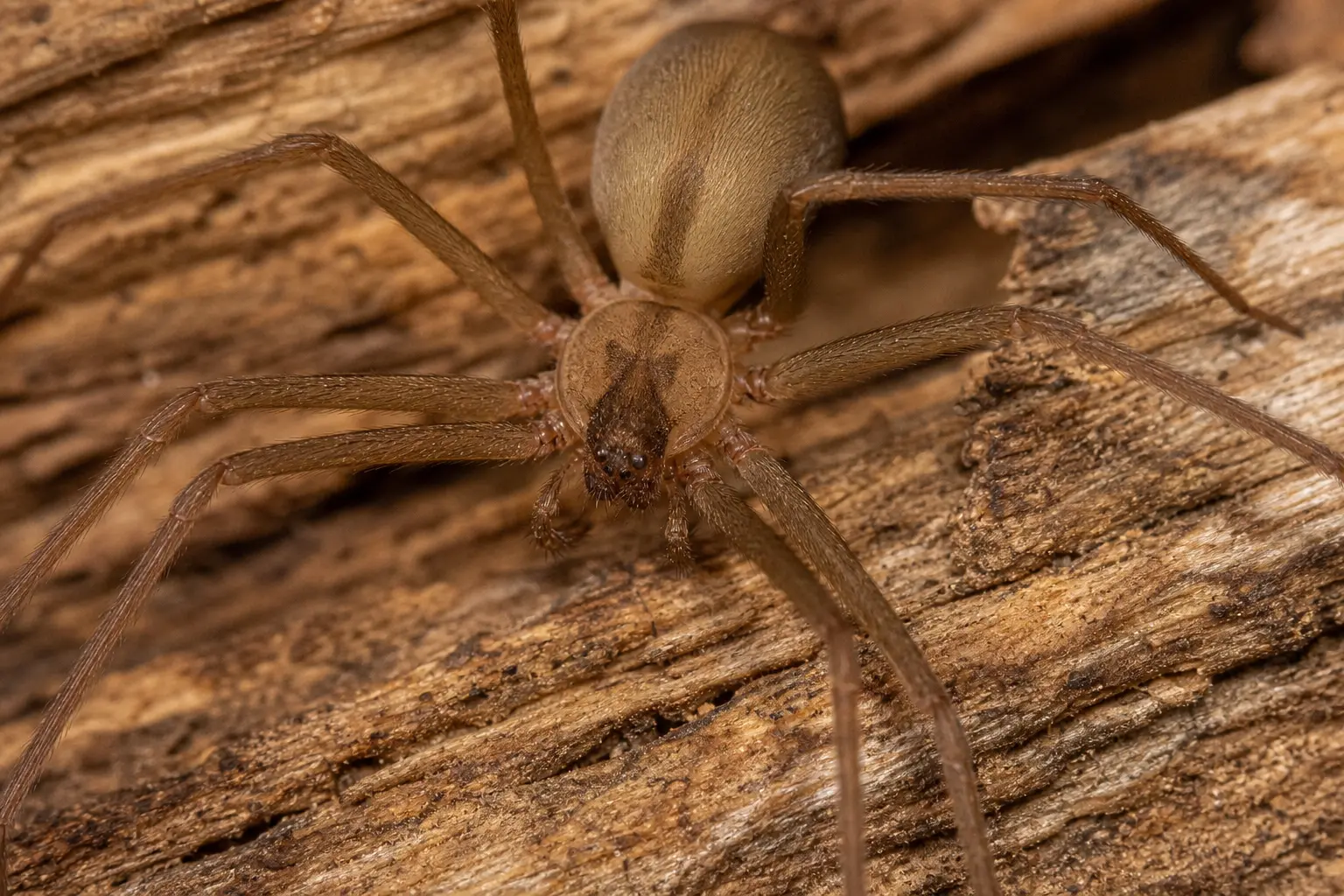
Recluse spiders carry only six eyes, arranged in three widely spaced pairs that form a shallow U shape across the front of the head. No headlamp glow, no reflective shine. If you can get close enough and safe enough to check (a photo from a few feet away works fine), six eyes in pairs settles the identification every time, no guessing required.
Arizona sightings tend to spike twice a year: during the spring warm up as insects and their predators both become more active, and again during monsoon season, when heavy rain drives ground dwelling spiders toward drier shelter, including garages, patios, and homes.
How Brown Recluse Spiders Actually Differ From Wolf Spiders
Eyes aside, the brown recluse vs wolf spider comparison is less close than the name confusion suggests. Wolf spiders are robust and unmistakably hairy, with thick, banded legs built for sprinting down prey on open ground. Their bodies run mottled brown to gray, sometimes with a paler stripe down the back, and adult females often carry a visible white egg sac attached to their spinnerets, a detail no recluse ever shows.
Recluse spiders are smoother, thinner legged, and noticeably less hairy. The signature mark, when present, is a dark violin-shaped marking on the cephalothorax (the front body section), which is where the nickname "fiddleback" comes from. Behavior differs just as much: a wolf spider is a ground hunting sprinter that builds no web at all, while a recluse spins a loose, irregular web tucked into undisturbed corners, more of a retreat than a hunting tool.
Body shape, leg thickness, hunting style, and web habits are all real differences worth learning, but they take a trained eye and a close look to apply with confidence. The eye count test above works from across a room, which is why pest professionals lead with it.
Why Arizona Has No True Brown Recluse (And What You're Actually Seeing)
Here is the detail most pest guides miss entirely: true brown recluse spiders, Loxosceles reclusa, have no established population anywhere in Arizona. They are a species of the central and southeastern United States. So how does a real brown recluse vs wolf spider matchup even come up here? Because Arizona has its own recluse relatives, close enough in appearance to explain every mix-up.
The desert recluse (Loxosceles deserta) lives across the western half of the state, especially dense in packrat middens, woodpiles, and undisturbed garage clutter. The Arizona brown spider (Loxosceles arizonica) covers similar Sonoran Desert areas. Both carry the same six eye, violin marked identity as their eastern cousin, and both are what a homeowner is actually looking at when they say "brown recluse."
Real brown recluses simply do not live here, but people keep the name because the desert relatives look close enough to matter. Both recluse spiders prefer the same quiet areas: closets, storage boxes, woodpiles, and undisturbed corners of garages, areas a wolf spider rarely bothers with since it hunts in the open instead of hiding in one.
| Feature | Wolf Spider (Hogna carolinensis) | Desert Recluse (Loxosceles deserta) |
|---|---|---|
| Eyes | 8, in 3 rows, 2 large center eyes | 6, in 3 pairs, U shaped |
| Body | Robust, hairy, banded legs | Smooth, slender legs, less hair |
| Marking | None; sometimes a pale dorsal stripe | Violin shaped mark on the cephalothorax |
| Web | None; hunts on foot, burrows in soil | Loose, irregular retreat web |
| Where found | Open ground, garages, patios, active at night | Woodpiles, packrat nests, storage boxes, western/central AZ |
| Bite risk | Mild, localized pain and swelling | Usually minor; a slow healing wound in a minority of documented bites |
Not sure which spider you're looking at?
A quick call gets you a straight answer, not a sales pitch. City Wide has been identifying Valley spiders for over 40 years and can tell you exactly what is living in your garage.
Meet Arizona's Real Wolf Spider: Hogna carolinensis
The wolf spider Arizonans see most often, especially the large ones that trigger a panicked text to the family group chat, is Hogna carolinensis, the Carolina wolf spider, North America's largest wolf spider species. Females run 22 to 35 millimeters in body length, with a leg span that makes them look considerably bigger than that.
These spiders dig and defend visible burrows in Arizona Upland habitat, sandy washes, and undisturbed yard corners, and they are most active from March through October. At night, their eyeshine is easy to spot crossing a driveway or a patio. Unlike a web building spider that waits for prey to arrive, a wolf spider actively hunts on the ground, using speed and eight strong legs instead of silk.
Why the Wolf Spider Is Actually on Your Side
This is the part that gets lost every time a wolf spider gets squashed by mistake: it is not a threat, it is pest control that is already on the payroll for free. Wolf spiders eat crickets, roaches, and other ground dwelling insects in serious volume, which makes them a genuine ally in keeping the bug population around a Valley home in check.
Count the eyes
Shine a light at night. Bright reflective eyeshine from two large eyes means wolf spider. No shine means take a closer look.
Check the body
Hairy, robust, and banded legs point to a wolf spider. Smooth, thin legged, with a violin mark points to a recluse.
Consider where you found it
Sprinting across an open garage floor in daylight fits a wolf spider. Tucked inside an undisturbed box or woodpile fits a recluse type.
Wolf spider bites, when they happen at all, produce mild, localized pain and swelling, similar to a bee sting, and nothing more. They are not aggressive. A wolf spider that sees you coming will run for cover or freeze in place; it will not chase, and it has no interest in your house beyond the bugs living in it. Compare that to a genuine brown recluse bite, which, while still uncommon and usually minor, occasionally causes a slow healing wound, one of the real differences worth knowing before deciding what to do about a spider on sight.
When a Spider Sighting Actually Needs a Professional
The bottom line: a wolf spider indoors is a nuisance, not a hazard, and killing one on sight only removes a insect eating ally you were not paying for. A genuine desert recluse sighting, especially repeated ones in the same closet, garage corner, or storage area, is the case worth a real look.
If you keep finding spiders with the violin marking, or a brown recluse bite is the worry that will not leave you alone, that uncertainty is reasonable, even University of Arizona extension entomologists note that recluse identification trips up experienced observers without a hand lens. Reducing the crickets and roaches a wolf spider hunts also thins out what draws spiders indoors in the first place, which is where routine general pest control does double duty against both the prey and the spiders following it in.
City Wide Pest Control has been family owned and locally owned and operated in Phoenix since 1986, holding Arizona pest control license #2317 and serving all of Maricopa County plus statewide Arizona. Spider identification calls are a routine part of that work, not an upsell, because a homeowner who knows what they are looking at makes a calmer decision either way.
Written by the City Wide Pest Team, City Wide Pest Control, Inc., Phoenix, Arizona. Family owned and locally owned and operated since 1986, Arizona license #2317.
Published: August 2026 | Last Updated: August 2026
Frequently Asked Questions
Do wolf spiders bite people?
Rarely, and only when handled or pinned against skin. A wolf spider bite causes localized pain and mild swelling similar to a bee sting and typically resolves on its own within a day or two. Any spider bite that keeps getting worse over several days deserves a doctor's look, but that outcome is rare with wolf spiders. Wolf spiders are not aggressive and will retreat rather than confront a person.
Is a wolf spider dangerous to have in my house?
No. Wolf spiders are not considered medically dangerous in Arizona; the bark scorpion is the only pest here with genuine medical significance. A wolf spider indoors is a sign it is hunting crickets or roaches, and removing it (or its food source) is a comfort decision, not a safety one.
Does Arizona have brown recluse spiders?
No. True brown recluses, Loxosceles reclusa, have no established Arizona population. What residents encounter are close relatives, the desert recluse (Loxosceles deserta) and the Arizona brown spider (Loxosceles arizonica), both of which share the six eye, violin marked identity people associate with "brown recluse." Any brown recluse vs wolf spider question asked in Arizona is really about one of these desert relatives.
How can I tell the two apart without getting close?
Distance identification relies on behavior and body shape rather than eyes, and those behavioral differences do most of the work at range. A large, hairy spider sprinting across open ground in daylight is almost always a wolf spider. A spider you only ever see tucked into an undisturbed box, woodpile, or closet corner is more likely a recluse type, worth a second look before handling anything nearby.
Should I kill a wolf spider if I find one inside?
There is rarely a reason to. Wolf spiders eat the crickets and roaches that actually cause problems in a home, so removing one (capture and release outside works fine) generally does more good than harm. If spiders keep showing up in numbers, that points to an insect food source worth addressing instead.
Ready to know exactly what's sharing your home?
City Wide has answered spider identification calls across Maricopa County for over 40 years, family owned and locally owned the whole way through.